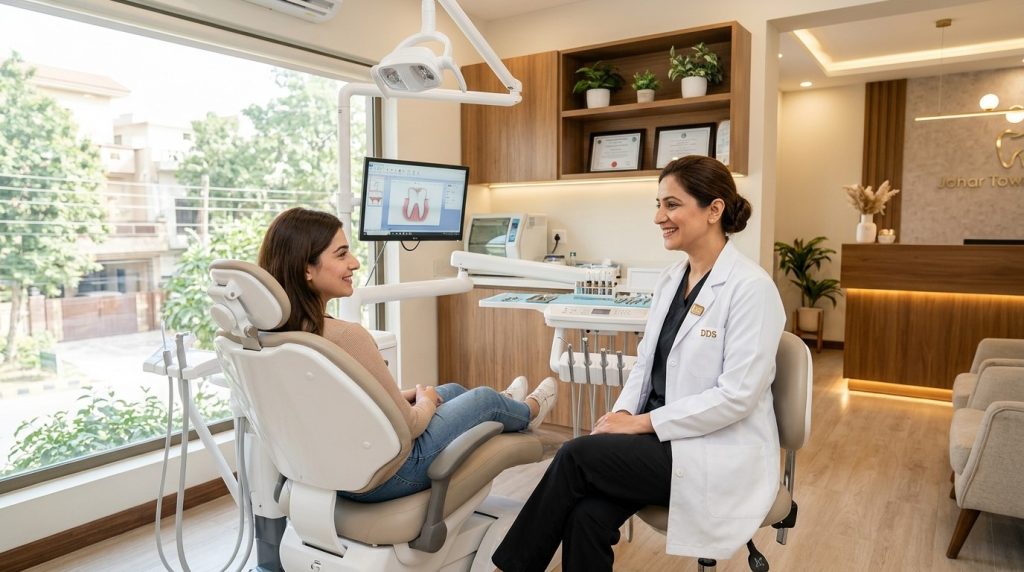
If you are searching for a female dentist in Johar Town, Lahore, you probably have a reason that matters to you. It might be comfort, privacy, cultural or religious preference, a stressful experience in the past, or the wish to find a dentist for your mother, daughter, or sister. Whatever the reason, it is a legitimate starting point for choosing a clinic.
A starting point is not a finish line, though. Choosing a dentist involves several separate questions: Is the dentist properly qualified? Is the clinic clean and safe? Will you be given honest explanations? Will costs be clear? And does the dentist’s gender actually change anything about your care? The reasoning tells you where the evidence is strong and where it is limited. It makes no promises about outcomes, because outcomes depend on your teeth, your health, and an examination that no article can replace.
Why Many Patients Prefer a Female Dentist
Dental care is intimate in a way that many other health visits are not. You lie back, your mouth is open, a clinician is working a few inches from your face, and you cannot speak easily. For some people, this vulnerability is manageable. For others it is a real barrier to seeking care at all. A preference for a female dentist Johar Town Lahore often grows from this.
Several reasons come up repeatedly:
- Modesty and cultural or religious comfort. In many families, women and girls are more comfortable receiving close physical care from another woman. This is a personal and valid preference, and clinics in Lahore commonly accommodate it.
- Ease of conversation. Some patients find it easier to discuss pregnancy, breastfeeding, hormonal changes, menstrual cycle effects on gums, or medication use with a female clinician.
- Past experiences. A previous painful or dismissive visit can make a patient want a fresh start with a different kind of clinician.
- Family arrangements. A parent may feel more comfortable sending a teenage daughter to a female dentist, or a husband may be more at ease with his wife’s treatment arranged this way.
- For people who feel nervous, familiarity and trust matter. If a female dentist makes the first visit feel less threatening, that can be the difference between attending and avoiding care.
Notice that each of these reasons is about comfort and trust. That is not a small thing. Research on dental anxiety consistently shows that avoidance leads to later, more complex problems. If a female dentist helps you attend regularly, that is a real benefit to your oral health.
What Gender Does Not Change
It is equally important to be clear about what a dentist’s gender does not decide. A female dentist is not automatically gentler, and a male dentist is not automatically rougher. Skill, technique, and temperament vary from person to person within every group. Clinical results depend on:
- the dentist’s training and continuing education
- experience with the specific procedure you need
- the quality of equipment and materials
- the clinic’s hygiene standards
- how carefully the dentist diagnoses before treating
- your own health, habits and home care
So the sensible approach is to treat “female dentist” as one criterion among several. It narrows your list, and then you evaluate the clinics on that list using the same standards you would use for anyone. Choosing solely on gender, without checking the rest, can leave you comfortable but poorly served. Choosing solely on price or convenience, ignoring your comfort, can leave you avoiding appointments. The best choice balances both.
Checking Qualifications and Registration
In Pakistan, dentists are expected to be registered with the Pakistan Medical and Dental Council (PMDC). A registered dentist has completed a recognised dental degree, such as a BDS, and holds a registration number. You are entitled to ask who will treat you and whether she is registered.
Some practical points:
- Ask directly and politely. A reputable clinic will not be offended. Many display certificates, and staff can tell you who the treating dentist is.
- Understand titles. A BDS is the basic dental degree. Further training, such as a postgraduate qualification or a specialty in an area like endodontics (root canals), orthodontics (braces), or periodontics (gums), represents additional study. A general dentist can perform many procedures, while complex cases are sometimes referred to a specialist. Referral is not a sign of weakness. It is often a sign of good judgment.
- Be cautious with vague claims. Phrases such as “internationally trained” or “expert” do not tell you much without specifics. Ask what the training was and when it took place.
- Remember that credentials are necessary, not sufficient. A qualification shows training. It does not guarantee that every treatment will go well. It simply tells you the dentist has met a baseline standard.
If a clinic cannot or will not tell you who is treating you, treat that as information.
Hygiene and Infection Control
Whatever the dentist’s gender, you are trusting the clinic to keep you safe from infection. Dental work involves saliva, sometimes blood, and instruments that enter your mouth. Good clinics follow established infection-control practices. You can observe several things yourself without any technical knowledge:
- Gloves and masks. The dentist and assistant should wear fresh gloves and a mask, and gloves should be changed between patients.
- Reusable instruments should come out of sealed sterilisation pouches or a clearly clean, separate area, not from an open tray where they have been sitting.
- Chair, light handles and tray surfaces should be wiped or covered between patients.
- Single-use items. Needles, suction tips and certain other items should be single-use.
- General cleanliness. A clean waiting room and treatment room are not proof of good sterilisation, but a visibly dirty one is a warning sign.
You are allowed to ask, “How do you sterilise your instruments?” A clear, confident answer is a good sign. Irritation or evasion is not.
Communication, Consent and Explanations
One of the strongest predictors of a good dental experience is whether you understand what is happening and feel you can say no or stop. A good dentist, regardless of gender, does the following:
- Explains the problem in plain language and shows you X-rays or photographs when relevant.
- Offers options, including the least invasive one, and explains the trade-offs.
- Gives estimates in advance, ideally in writing for anything beyond a basic visit.
- Obtains your agreement before starting treatment, rather than assuming it.
- Invites questions and answers them without pressure.
- Sets up a stop signal, such as raising your hand, so you can pause during treatment.
If you ever feel rushed, talked down to, or pushed toward expensive treatment without a clear reason, you are free to pause, ask for the plan in writing, and take time. Seeking a second opinion is a normal part of healthcare.
Common Reasons to See a Dentist
People visit a dentist for very different reasons. Here is an overview of the most common ones, with honest notes about what each involves.
Routine check-ups and cleaning
A check-up involves an examination of your teeth, gums, tongue and soft tissues, sometimes with X-rays. A professional cleaning, often called scaling, removes plaque and hardened tartar that brushing cannot. Many dentists suggest a visit roughly every six months, but the right interval depends on your risk. Someone with a history of gum disease may need more frequent visits, while someone with consistently healthy teeth may be advised a longer gap. A good dentist explains why she recommends a particular interval rather than simply applying a rule.
Fillings and cavities
Tooth decay is common and treatable, particularly when found early. Small cavities are usually filled with tooth-coloured composite or other materials. Larger ones may need an inlay, onlay or crown. Filling materials wear over time and may eventually need replacement. A dentist should be able to explain which material she suggests and why.
Root canal treatment
When the pulp inside a tooth becomes infected or irreversibly damaged, a root canal may be recommended to remove the damaged tissue and seal the tooth. It is intended to save the tooth, but it is not guaranteed to succeed in every case, and most treated teeth need a crown or strong restoration afterwards. Ask why a root canal is suggested instead of a filling or extraction, and what each option would involve.
Gum care
Bleeding when you brush is a common sign of gum inflammation, called gingivitis, which is often reversible with good cleaning and home care. Left alone, it can progress to periodontitis, which involves loss of the supporting bone and is managed rather than cured. If your gums bleed regularly, that is a reason to be examined, not to brush less.
Cosmetic care
Whitening, bonding, veneers, and similar treatments change how teeth look. Results vary, materials wear, and some treatments, such as porcelain veneers, involve removing enamel that cannot be replaced. A responsible dentist discusses reversibility, upkeep and realistic expectations. Be wary of promises of a “perfect smile.”
Care for children and teenagers
Many dental organisations suggest a child’s first dental visit around the time the first tooth appears or by the first birthday, though practices vary. Some parents prefer a female dentist Johar Town Lahore, for a nervous child. What matters most is a patient clinician who explains things at the child’s level and focuses on prevention such as brushing technique, diet and sealants where appropriate.
Pregnancy and hormonal changes
Hormonal changes during pregnancy can make gums more prone to swelling and bleeding, a condition often called pregnancy gingivitis. Tell your dentist if you are pregnant or trying to conceive. She can take this into account when deciding timing, medication, and whether imaging is needed. Routine check-ups and cleaning are commonly considered appropriate during pregnancy, while some dentists prefer to schedule non-urgent or elective work at certain stages. Because individual circumstances differ, this is a decision to make with your dentist and, where relevant, your doctor.
Dental Anxiety: How a Good Clinic Responds
Fear of the dentist is common and not a character flaw. If it applies to you, look for a dentist who treats it seriously. Helpful practices include:
- a brief first visit that involves only a conversation and a gentle examination
- explaining each step before doing it, a “tell-show-do” approach
- agreeing a stop signal and honouring it
- allowing short breaks
- adequate numbing before procedures that need it
- unhurried appointment times
Some clinics also offer other methods of relaxation for anxious patients. These vary in availability and suitability, and some involve medical risks, so ask what is offered, who administers it and what the precautions are. Avoid clinics that dismiss your fear or promise that “you will feel nothing” without explanation. A more honest statement is that the area will be numbed and you should feel pressure but not sharp pain, and that you can say if something hurts.
What Your First Visit Usually Looks Like
Knowing what to expect can ease nerves. A typical first appointment includes:
- Welcome and paperwork. You will be asked for your contact details, medical history, medications, and allergies. Be honest and complete. Conditions such as diabetes, heart problems, bleeding disorders or pregnancy affect treatment decisions.
- A conversation. The dentist asks what brought you in, and about pain, sensitivity, bleeding, habits such as grinding, and previous dental work.
- Examination. She checks teeth, gums, bite and soft tissues, and may use a small mirror and probe.
- X-rays if justified. Imaging should be used when it is likely to change a decision, such as checking between teeth or around roots. You can ask why a particular X-ray is needed.
- Explanation of findings. You should hear what she found, what is urgent and what can wait.
- A plan and estimate. For anything beyond a simple cleaning, ask for a written outline of recommended treatment, in order of priority, with costs.
- Time to decide. Unless a problem is urgent, you can go home, think and ask questions.
Not every first visit includes treatment, and that is normal.
Understanding Costs Without Surprises
Dental pricing in any city varies with the treatment, the materials, the dentist’s experience, and the clinic’s setup. For that reason, comparing costs requires care. A few principles help:
- Compare like with like. A cheaper filling using one material is not the same as a more expensive one using another. Ask what is included.
- Ask for itemised estimates. For multi-step treatments such as root canal plus crown, ask for each part to be listed.
- Ask about follow-up. Does the quote cover review visits? What happens if something needs adjustment?
- Consider lifespan. A treatment that lasts longer may cost more upfront but less over time, although no one can promise how long any restoration will last.
- Beware of pressure. Time-limited discounts on major treatment should not stop you from asking questions or seeking another opinion.
- Prevention is usually cheaper. Regular check-ups tend to catch problems earlier, when treatment is simpler, though this is a general pattern rather than a rule.
We have not listed specific prices here, because they change and a printed figure could mislead you. Ask the clinic for a current written estimate.
How to Compare Clinics in Johar Town
Johar Town has many dental practices, so it helps to have a simple method. Try this:
- Make a shortlist of clinics that have a female dentist available. Ask by phone whether you can book with her specifically, and on which days.
- Ask your four key questions: Who will treat me, and what are her qualifications? How do you sterilise instruments? Will I receive a written estimate? What happens if I am in pain between appointments?
- Check practicalities: location, parking, opening hours, how appointments are handled, and whether the clinic can see you promptly for urgent problems.
- Read reviews with care. Reviews can be useful, but they can be edited, selective or unverified. Look for patterns, not single dramatic comments, and treat perfect scores with some scepticism.
- Trust your impression of the first visit. Did the dentist listen? Did you understand what she said? Did you feel respected?
You do not owe loyalty to the first clinic you try. If it does not feel right, you can choose again.
Red Flags Worth Noticing
No clinic is perfect, but certain behaviours should make you pause:
- guarantees of results or permanence
- refusal to share the treating dentist’s name or credentials
- pressure to decide immediately on expensive treatment
- no clear explanation of why a treatment is needed
- no written estimate for major work
- visibly poor hygiene
- dismissing your questions or your pain
- recommending large amounts of treatment with no X-rays or examination to support it
One red flag does not prove poor care, but several together are a good reason to look elsewhere.
About Elora Dental and Aesthetics
Elora Dental and Aesthetics is a dental and aesthetic clinic in Johar Town, Lahore. Patients who prefer a female dentist can contact the clinic to ask about booking with one. We do not claim to be the best clinic in Lahore, because that is a claim no one can fairly prove. What we can do is give you the information you need to decide: who will treat you, what the examination involves, what your options are, and what they are likely to cost, in writing where appropriate.
Please contact the clinic directly to confirm current opening hours, which dentist is available on which days, the services offered and what a first consultation covers. Details can change, and a quick call will give you the most accurate picture.
Final Explanation
Choosing a female dentist in Johar Town is a reasonable, personal decision, and wanting to feel comfortable is a good reason to seek out the right clinician. The strongest results come from treating that preference as the beginning of your search. Then check the dentist’s registration, observe the clinic’s hygiene, expect clear explanations, ask for written estimates, and trust your own impressions. Be wary of anyone who promises perfect or guaranteed results, because dental care depends on factors no clinic fully controls.
If you have not had a dental examination in the past year, aim to book one before the end of 2027. A regular check-up gives you a baseline, helps catch problems early and lets you build a relationship with a dentist you trust. A practical first step is to contact Elora Dental and Aesthetics, ask about booking with a female dentist, and put the four key questions above to her. Then compare the answers with what any other clinic tells you, and choose the one that explains things most clearly.
Frequently Asked Questions
How do I know a female dentist is properly qualified?
Ask for her qualifications and her PMDC registration details. A reputable clinic will answer without hesitation. A recognised dental degree and registration show that she has met a baseline standard, but they do not guarantee any particular result. Beyond paperwork, notice whether she explains your problem clearly, offers options and welcomes questions, since these are practical signs of careful practice.
What can I expect at my first appointment?
Expect a conversation about your health and concerns, an examination of your teeth and gums, and possibly X-rays if they are justified. The dentist should then explain her findings and, if treatment is needed, outline a plan with estimated costs. Treatment may not begin at the first visit, and you are free to take time before agreeing to anything. If you feel nervous, tell her at the start so she can adjust her approach.
Why do some patients feel more comfortable with a female dentist?
Reasons differ from person to person. Some relate to modesty and cultural or religious norms, others to ease in discussing topics such as pregnancy and hormonal changes, and others to past experiences or anxiety. These are valid reasons for choosing a dentist, but they concern comfort and trust rather than technical ability. Skill depends on training, experience, and care, not gender.
How often should I visit the dentist?
Many dentists suggest check-ups about every six months, but the right interval depends on your own risk of decay and gum disease. People with a history of gum problems, frequent cavities, smoking, or certain medical conditions may be advised to come more often. Those with consistently healthy teeth may be told a longer gap is fine. Ask your dentist to explain the reasoning for your case.
What should I do if I have a toothache and cannot wait?
Call the clinic and describe your symptoms, since staff can often advise how urgent it is. Rinsing gently with warm water and following the label of any over-the-counter pain relief may help in the short term, but these measures do not treat the cause. Seek urgent medical care straight away if you have facial swelling that is spreading, a fever, or difficulty swallowing or breathing, as these can signal a spreading infection.