Light is the most ordinary thing in the world. It fills the room you are sitting in, it ripens the mangoes you wait for every summer, and it is also the reason your skin remembers every hour you spent in the Lahore sun.
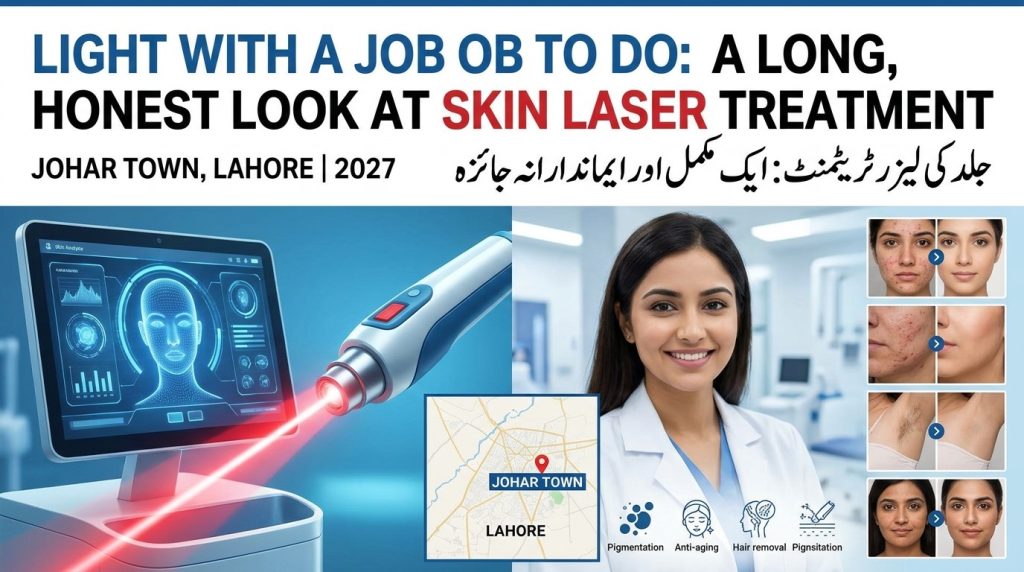
Skin Laser Treatment in Johar Town, Lahore takes that ordinary thing and gives it a job. A laser is light with its wavelength, energy, and timing chosen on purpose. Aimed at the right target, in the right dose, by the right hands, it can fade certain kinds of pigment, reduce unwanted hair, soften some scars, and calm some types of redness. Aimed carelessly, it can do the opposite.
This guide isn’t a gallery of dramatic before-and-after photos, and it isn’t a price list. It is a long conversation about one question that sits underneath every laser treatment: what, exactly, is the light being asked to do, and is that the right job for your skin?
If you are considering laser treatment in Johar Town, Lahore, this is the guide we would want you to read before you ever step into a clinic.
Part One: The Physics You Actually Need
You don’t need a physics degree to choose a laser treatment well, but one idea explains almost everything: selective absorption.
Different structures in your skin soak up different kinds of light. A laser is tuned to a particular wavelength, and that wavelength is absorbed most strongly by a particular target. The absorbed light turns into heat, and that heat does the work.
The main targets are:
- Melanin, the pigment that gives skin and hair their colour. Light absorbed by melanin is the principle behind many treatments for dark spots and for laser hair reduction.
- Haemoglobin, the pigment in blood. Lasers tuned to it are used for certain types of redness and visible small vessels.
- Water, which makes up much of the skin’s tissue. Lasers absorbed by water are the basis of many resurfacing treatments, which remove or heat very thin layers of skin to trigger renewal.
This is why the phrase “laser treatment” on its own tells you almost nothing. It is like saying “medicine.” Which one? For what? A device suited to hair reduction is not the one you would choose for acne scars, and a practitioner who treats every concern with the same machine deserves a polite question or two.
Why the same laser can be wonderful for one person and risky for another
Because melanin absorbs laser light, the amount of melanin in your skin changes how the light behaves. Skin with more melanin absorbs more energy at the surface. That doesn’t make laser treatment impossible, but it does change which devices, settings, and techniques are safe. We will return to this, because for patients in Pakistan it is the single most important thing to understand.
Part Two: Four Skin Stories
Instead of walking through a menu of procedures, let’s think about four common concerns the way a careful practitioner would. For each, the first job is not choosing a laser. It is working out what is actually going on.
Story one: The patch that never leaves
Pigmentation is one of the most frequent reasons people ask about lasers, and it is also one of the most misunderstood. Dark patches on the face or body have many causes:
- Sun exposure over the years
- Hormonal changes
- Marks left behind after acne or injury
- Reactions to certain products or medications
- Conditions such as melasma, which is notoriously stubborn
These are not the same problem, and they don’t respond to the same treatment. Some forms of pigmentation can actually worsen when heated by the wrong laser, because heat and inflammation can stimulate pigment cells. That is why the diagnosis comes before the device.
A thoughtful practitioner will ask when the pigmentation appeared, whether it changes with the seasons, which products you use, and what medicines you take. They may suggest sun protection and topical care first, and use laser only where it is appropriate. If someone offers a quick laser fix for a pigment patch without asking a single question, treat that as a sign to slow down.
Story two: The scars that outlasted the acne
Acne can leave behind more than marks. Some people are left with textural changes: shallow dents, uneven surface, enlarged-looking pores. Treatments aimed at this typically work by creating controlled, microscopic injury in the skin, which prompts the body’s repair response and the production of new collagen.
Here the honest message is about pace and expectations. Improvement is usually gradual and happens over a series of sessions spaced weeks apart. It is often partial rather than total, and deep scars tend to respond less than shallow ones. Skin also needs time to recover between sessions.
A good clinic will tell you this at the start. A clinic that promises smooth, flawless skin from a single session is telling you what you want to hear, not what the biology allows.
Story three: The razor you are tired of
Laser hair reduction is among the most requested skin laser treatments in Johar Town, Lahore, in the world. It works by targeting the pigment in the hair follicle, delivering enough heat to damage it so that it grows less hair.
A few realities help set expectations:
- It works best when there is good contrast between hair colour and skin colour, because the laser needs a pigmented target.
- Hair grows in cycles, and the laser affects follicles that are in the right phase, which is why several sessions are needed, spaced weeks apart.
- The common medical description is hair reduction, not guaranteed permanent removal. Many people see a significant decrease, though some hair may return and occasional maintenance sessions are common.
- Very light, grey, or white hair contains little pigment and often responds poorly.
Hormonal conditions can also influence hair growth, so persistent or sudden excess hair sometimes deserves a medical conversation, not only a cosmetic one.
Story four: The redness that won’t settle
Facial redness, visible tiny vessels, and some other vascular concerns can be treated with lasers that target blood. But redness has many causes, including rosacea, sun damage, sensitive skin, and inflammatory conditions. Some respond well to certain lasers, and others need medical management. Again, the cause decides the plan.
Part Three: The Part That Matters Most in Lahore
Many general articles about laser treatment are written with lighter skin in mind. Lahore is not that context, so let’s be direct about it.
Skin tone changes the risk profile
Because melanin absorbs laser energy, darker skin tones carry a higher risk of side effects if the wrong device or settings are used. Those risks can include temporary darkening, temporary lightening, blistering, or, less commonly, longer-lasting pigment changes.
This does not mean people with brown or darker skin cannot have laser treatment. It means the following matter a great deal:
- The device. Some lasers and wavelengths are considered safer for higher melanin levels than others.
- The settings. Energy level, pulse duration, and cooling all affect safety.
- The practitioner’s experience. Someone who regularly treats skin like yours will have a better feel for how it responds.
- The approach. Starting conservatively and using test patches where appropriate is sensible.
When you visit a clinic, a good question is: “Which device would you use on my skin tone, and why?” A confident, specific answer is reassuring. A vague one is not.
The Lahore sun is part of the treatment plan
Laser treatment and sun exposure are a poor combination. Treated skin is more sensitive, and sunlight can trigger pigmentation problems or undo the results you paid for. Many practitioners advise limiting sun exposure and using high-protection sunscreen before and after treatment.
In a city where summers are long and bright, that is not a small footnote. It affects when you start treatment, too. Many people choose to begin in the cooler months, when it is easier to stay out of strong sun, though the right timing depends on your skin and the treatment.
Tanning and sun-seeking habits
If you have recently been tanned, or you spend long hours outdoors, tell your practitioner. It can change whether treatment should go ahead and how it should be adjusted. Honesty at the consultation protects your skin.
Part Four: What a Good Consultation Feels Like
A laser consultation should feel closer to a diagnosis than a sales pitch. If you are wondering what to expect, here is what a careful one looks like.
1. Questions about you.
Your skin history, previous treatments, medications, supplements, skincare products, sun habits, and any history of scarring, cold sores, or unusual reactions. Some medicines make skin more light-sensitive, and some conditions affect healing, so these questions are not small talk.
2. A proper look at your skin.
Your skin type, the specific concern, and its likely cause are assessed. Sometimes this includes a close examination under magnification or special lighting.
3. An explanation, not a script.
You should hear which approach suits your case, why, and what alternatives exist, including non-laser options and the option of waiting.
4. Honest numbers.
How many sessions might be needed, how far apart, what improvement is realistic, and what total cost to expect.
5. A frank talk about risks.
Redness, swelling, temporary darkening, sensitivity, and rarer complications should be discussed plainly.
6. Clear instructions.
Preparation and aftercare, ideally in writing.
If you leave a consultation with questions answered and no pressure to sign up on the spot, the clinic has done its job.
Part Five: A Short Checklist to Verify Before You Book
Keep this list on your phone when you visit or call a clinic.
- Who will perform the treatment, and what is their training? Ask directly. Treatments should be carried out by suitably trained people.
- Is the device appropriate for my skin tone? Not every laser suits every skin type.
- Is a patch test offered where appropriate? A small test area can reveal how your skin reacts before a full treatment.
- Is the equipment properly maintained and are hygiene standards visible? Clean rooms, fresh disposables, and protective eyewear for everyone in the room are basics.
- What are the realistic outcomes and the possible side effects? You should hear both.
- What does the price include? Ask whether the number covers a single session or a course, and whether consultations and follow-ups are included.
- What aftercare is expected, and who do I contact if something goes wrong? A clinic that stands behind its work will have a clear answer.
Part Six: Mistakes Worth Avoiding
Some missteps come up again and again.
Choosing on price alone. Very cheap packages sometimes reflect shortcuts in equipment, training, supervision, or follow-up. That doesn’t mean expensive is always better, but price should be one factor among several.
Treating a laser like a salon service. A laser is a medical-grade tool. It deserves the seriousness of a procedure, even when it feels quick and comfortable.
Tanning before or after sessions. It raises the risk of pigmentation problems and can force treatment to be postponed.
Skipping aftercare. Treated skin needs gentle products and sun protection while it recovers.
Expecting overnight results. Most laser treatments work gradually and need a series of sessions. Some effects only become visible after weeks.
Picking at or scrubbing treated skin. Peeling, scabbing, or flaking should be left alone unless your practitioner says otherwise.
Combining treatments without advice. Using strong skincare actives or other procedures around laser sessions can irritate skin. Check first.
Hiding information. Medications, recent sun exposure, and past reactions all matter. Your practitioner can only protect you from what they know.
Part Seven: Before, During, and After
Knowing what a typical treatment journey looks like takes much of the fear out of it. Exact steps vary by treatment and clinic, but the broad outline is similar.
Before
- Follow the preparation your practitioner gives you, which often includes avoiding sun exposure and certain products.
- For hair reduction, you may be asked to shave the area beforehand and avoid waxing or plucking, since the follicle needs to be present.
- Tell the clinic about any new medicines, infections, or skin changes before your appointment.
During
- Protective eyewear is standard for the patient and anyone in the room.
- The skin may be cleaned, and sometimes numbing cream or cooling is used to improve comfort.
- You may feel warmth, a snapping sensation, or a prickling feeling, depending on the treatment. Tell your practitioner if anything feels too intense.
- Sessions can be short, sometimes minutes for small areas and longer for larger ones.
After
- Mild redness or swelling is common and usually settles in hours to days, though this depends on the treatment.
- Gentle skincare, avoiding heat, and strict sun protection are typical advice.
- Don’t pick at the skin, and avoid harsh products until your practitioner says it is fine.
- Contact the clinic if you notice blistering, severe pain, signs of infection, or anything that worries you.
Part Eight: Why Patience Is the Real Active Ingredient
Skin does not change on the schedule of our impatience. Skin cells turn over on a cycle of weeks. Collagen remodels over months. Hair grows in phases. That is why so many laser treatments are delivered as a series, with gaps between sessions.
This matters for two reasons.
First, it protects you from disappointment. If you expect a result after one session and don’t see it, you may conclude the treatment failed when it was simply incomplete. Second, it protects you from overtreatment. Cramming sessions together, or chasing faster results with higher settings, is how skin gets hurt.
A useful mindset is to treat laser treatment as a project, not an event. Agree a plan with your practitioner, review progress together, and be ready to adjust. A good clinic will tell you honestly if a treatment isn’t working, rather than simply booking another session.
Part Nine: How to Think About Cost
Cost is part of every real decision, so let’s treat it plainly.
Skin laser pricing varies widely, and the cheapest option is not always the best value, just as the most expensive isn’t automatically the best. Here are better questions than “how much per session?”
- What is the total cost of the course? Some concerns need several sessions.
- What does it include? Consultation, numbing, aftercare products, and follow-up should be clear.
- What is the cost of getting it wrong? Correcting pigmentation problems or scarring caused by poor treatment can cost far more than doing it properly the first time.
- What is the alternative? Sometimes good sun protection and a simple topical routine do as much as a laser for certain concerns, at a fraction of the price. An honest clinic will say so.
A fair price is one that reflects real equipment, real training, proper hygiene, and enough time with you. If a deal looks too good, ask which of those has been trimmed.
Part Ten: When Laser Isn’t the Answer
It may sound odd for a clinic to say this, but sometimes the best advice is not to have a laser treatment, or not yet.
- If a skin concern is changing quickly, bleeding, or looks unusual, such as a mole that has changed, it needs medical assessment first. Cosmetic treatment is not the place to start.
- If you are pregnant or breastfeeding, some treatments are typically postponed.
- If your skin is currently sunburned, inflamed, or infected, treatment usually waits.
- If you are taking certain medications that increase light sensitivity or affect healing, your practitioner may adjust or delay treatment.
- If your goals are unrealistic, a candid conversation is better than a disappointing course.
A clinic that is willing to say “not now” or “not this” is usually one you can trust when it says “yes.”
Part Eleven: Why Elora Takes This Approach
Elora Dental and Aesthetics in Johar Town grew from a simple belief: the same principles that make good dentistry trustworthy apply to skin. Examine first. Explain plainly. Respect the patient’s right to decide with full information. Don’t promise what biology can’t deliver.
For skin laser treatment, that means:
- Assessing your skin and concerns before recommending anything
- Discussing how your skin tone affects the choice of approach
- Being straightforward about the number of sessions and the realistic outcome
- Explaining risks and aftercare clearly
- Telling you if another option would serve you better
We would rather you leave a consultation with understanding than with a booking you aren’t sure about.
Let the Light Work for You Before the End of 2027
Skin concerns rarely resolve by waiting, and many are easier to manage when they are assessed early. If something about your skin has been bothering you, whether it is a patch that won’t fade, scars that remind you of a difficult year, or hair you are tired of managing, a consultation costs little and tells you a great deal.
A sensible plan looks like this:
- Book an assessment now. Learn what is causing your concern and whether laser is the right tool.
- If treatment is suitable, start in the cooler months so sun exposure is easier to manage.
- Commit to the process. Follow the schedule and the aftercare.
- Review progress with your practitioner, and adjust the plan together.
Do that, and by the end of 2027 you could have a completed course, healthier skin, and, just as importantly, a clear understanding of how to look after it.
The light is the same ordinary light it has always been. What changes the outcome is how carefully you use it.
Elora Dental and Aesthetics, Johar Town, Lahore. Call or message us to book your skin consultation.
FAQs
How does laser treatment actually work on the skin?
A laser delivers a specific wavelength of light that is absorbed by a particular target in the skin, such as pigment, blood vessels, or water in the tissue. The absorbed energy becomes heat and produces a controlled effect, which might be damaging a hair follicle, breaking up pigment, or stimulating the skin to renew itself. Different concerns need different devices and settings, which is why a proper assessment comes first.
What skin concerns can laser treatment help with?
Laser treatments are commonly used for unwanted hair, some types of pigmentation, textural scarring, certain kinds of redness, and skin renewal. Whether laser suits your concern depends on its cause and on your skin type. Some concerns respond better to other approaches, and an examination is the only reliable way to know which applies to you.
Why does skin tone matter so much for laser treatment?
Melanin absorbs laser energy, so darker skin has a higher risk of pigment-related side effects if the device or settings are unsuitable. Experienced practitioners choose equipment and settings designed for your skin tone, often start conservatively, and may perform a patch test. This is one of the most important factors in a safe treatment, particularly for patients in Pakistan.
How many sessions will I need, and how soon will I see results?
It depends on the concern, the area, and your skin. Hair reduction and scar treatments usually involve a series of sessions spaced weeks apart, and visible changes often develop gradually over weeks or months. A practitioner should give you a realistic estimate after examining your skin, not a fixed promise. Results vary between individuals.
Why is sun protection so important after laser treatment?
Treated skin is more sensitive and more prone to pigmentation changes when exposed to sunlight. Using sunscreen and limiting direct sun before and after sessions helps protect your results and lowers the risk of side effects. In a sunny city like Lahore, this is as important as the treatment itself.