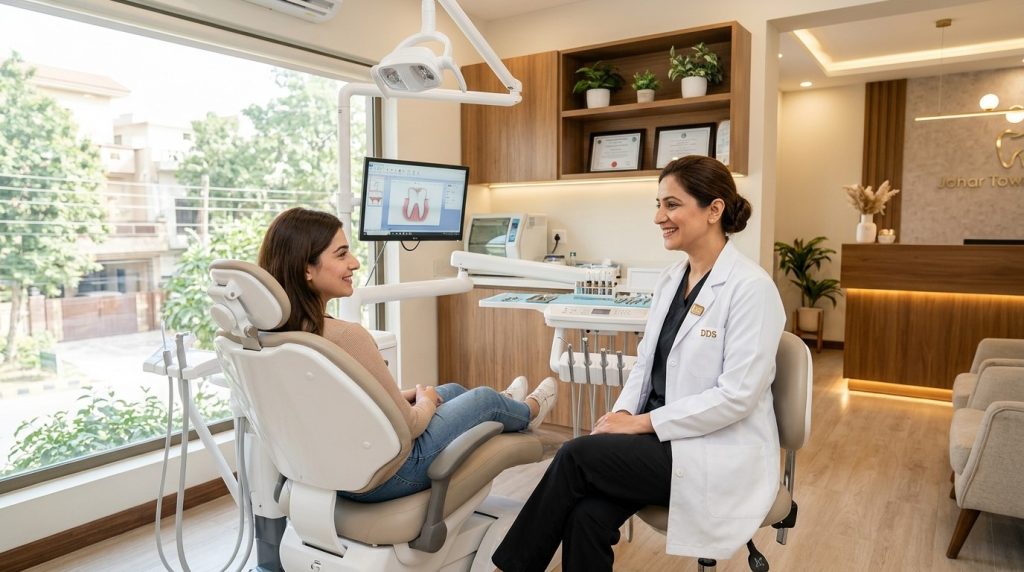
You have tried lying flat, then propping yourself up on two pillows, then pacing the corridor with a hand pressed to your jaw. The painkiller you took an hour ago has done almost nothing. Your phone is bright in the dark, and you are typing a search you never expected to need: Emergency Dentist Johar Town. If that moment sounds familiar, you are in good company. Dental emergencies rarely announce themselves. They arrive after a hard bite of something you thought was soft, during a cricket match in the street, or on a Friday evening when everything seems to be closing. They also show up in the middle of the night, when fear is at its loudest and information is at its thinnest.
Everything here is general education. It cannot replace an examination, and it cannot tell you what is happening in your particular mouth. When in doubt, contact a dentist.
What Actually Counts as a Dental Emergency?
The word “emergency” gets used loosely. A whitening appointment you would like sooner is not an emergency. A tooth that has been mildly sensitive for a month is not one either, though it deserves attention. The useful distinction is between three categories.
Urgent and time-critical. These cases get worse, or become harder to fix, with every hour of delay:
- A tooth knocked out completely
- A tooth pushed out of position
- Swelling of the face, jaw or gum, especially if it is spreading
- Bleeding that does not slow after ten minutes of firm pressure
- A broken tooth with a visible pink or red centre, or sharp pain on exposure to air
- Pain so intense that sleep, eating or concentration is impossible
Prompt but not frantic. These should be seen within a day or two:
- A lost filling or crown
- A chipped tooth without significant pain
- A broken wire or bracket that is cutting into the cheek
- Persistent, lingering pain after hot or cold food
Routine. Cosmetic concerns, mild sensitivity, and long-standing staining belong here. They are worth a proper appointment, not an emergency slot.
Why does this matter? Because one of the most common mistakes people make is treating a time-critical problem as routine (“I’ll wait until Monday”) or treating a routine one as a crisis and exhausting themselves. Sorting your situation into the right category first helps you decide how quickly to move and how much to worry.
Why Teeth Seem to Hurt Worse at Night
Almost every dentist has heard the same sentence: “It was fine all day, and then it exploded at night.” This is not your imagination, and it is not a coincidence. There are at least three plausible reasons, and they stack.
Posture changes blood flow. When you lie flat, more blood reaches your head. Inside a tooth, the soft tissue (the pulp) sits in a rigid chamber with no room to expand. If that tissue is already inflamed, even a small increase in pressure can turn a dull ache into a throbbing one. This is part of why many people feel better sitting upright with the head raised.
Distraction disappears. During the day, work, traffic, and conversation compete for your attention. At night, the pain has no competition. Pain perception is strongly influenced by attention and anxiety, so the same signal can feel far louder in a silent room.
Habits you do not control. Some people clench or grind their teeth in their sleep. A tooth that is already cracked or inflamed can react sharply to that pressure.
None of this changes the underlying problem, so night-time pain should not be dismissed as “just the night.” What the pattern does tell you is that the pulp may be inflamed, which is a reason to get examined and not simply to wait for morning to pass.
One more clue worth noticing: how the pain behaves. Pain that appears sharply with cold or sweet food and fades within seconds often points to a milder, potentially reversible irritation. Pain that lingers for a minute or more after the trigger is gone, or that starts on its own without any trigger, more often suggests a deeper problem. Dentists use this distinction when deciding how urgent treatment is. You cannot diagnose yourself with it, but describing it clearly to a dentist helps them considerably.
The First Hour: What to Do Before You Reach the Chair
The goal of the first hour is not to fix the problem. It is to protect the tooth, control discomfort, and avoid making things worse. Here is how to handle the most common situations.
Severe toothache
Rinse gently with lukewarm water. If food is trapped between teeth, a careful pass with dental floss can sometimes relieve pressure dramatically. Do not force it, and stop if it hurts sharply.
For pain relief, follow the instructions on the label of the over-the-counter painkiller you normally use safely, and respect the maximum daily dose. People with stomach ulcers, kidney problems, asthma, sensitivity to anti-inflammatory drugs, pregnancy or other medication use should check with a pharmacist or doctor first. If you are unsure, ask rather than guess, because a toothache is not worth a medication problem.
Two old habits deserve to be retired. First, do not place an aspirin tablet directly against the gum. It can burn the soft tissue and does nothing to speed pain relief. Second, be cautious with home remedies such as clove oil. A tiny amount on a cotton bud can numb temporarily, but undiluted use can irritate or damage gum tissue, and it will not treat whatever is causing the pain.
Swelling
Use a cold compress on the outside of the cheek, ten minutes at a time with breaks in between. Avoid heat. Warmth may feel soothing, but if an infection is present, heat on the face can encourage it to spread. Keep your head elevated when resting.
Swelling matters more than pain in one respect: it can signal infection, and infections in the mouth can travel. If swelling is increasing, see the red-flag section below.
A tooth knocked out
This is the situation where minutes genuinely count. The steps are specific:
- Pick the tooth up by the crown, the white chewing part, never by the root.
- If it is dirty, rinse it very briefly with milk or clean water. Do not scrub, scrape or use soap or disinfectant. The root surface carries delicate tissue that you want to preserve.
- If you can, and only if the person is conscious and an adult, gently place it back into the socket and have them bite softly on a clean cloth to hold it.
- If that is not possible, keep it moist, ideally in cold milk or in the mouth between the cheek and gum, if the person is old enough not to swallow it. Plain water for long periods is not ideal. Never wrap it dry in tissue.
- Go to a dentist immediately.
A permanent (adult) tooth has a far better chance of surviving when it is reimplanted quickly, with outcomes generally best within the first hour. Baby teeth are different: they are not pushed back in, because that can damage the developing adult tooth underneath. A baby tooth knocked out still deserves a dental check, but it is usually less of a race.
A cracked or broken tooth
Rinse the mouth with lukewarm water. Keep any fragment, as sometimes it can be bonded back, and bring it with you. Cover sharp edges with dental wax or sugar-free chewing gum if the tongue or cheek is being cut. Avoid chewing on that side.
A visible pink or red spot inside a broken tooth, or sharp pain with air or temperature, suggests the inner pulp may be exposed. That moves the case into “see someone today” territory.
Bleeding
Apply firm, steady pressure with clean gauze or a damp cloth for ten minutes without lifting to check. Constantly peeking restarts the clotting process. If bleeding persists beyond that, or you take blood-thinning medication, contact a dentist or doctor promptly.
Pain after a recent extraction
If you had a tooth removed two to four days ago and the pain is getting worse instead of better, with a bad taste or visible empty socket, that pattern can indicate a dry socket, where the protective clot has been lost. It is painful but treatable, and it needs a dentist. Avoid spitting, straws, and smoking, all of which can disturb healing.
Red Flags: When It Is Not Just a Dental Problem
Most dental emergencies are painful but contained. A small number are medically dangerous. Seek emergency dental care at a hospital, rather than waiting for a dental appointment, if you experience any of the following:
- Swelling that spreads to the eye, neck, or under the chin
- Difficulty breathing, swallowing or opening the mouth
- A fever with facial swelling
- Swelling after a significant blow to the head or face, or any suspected jaw fracture
- A rapidly worsening condition, or you feel generally very unwell
The reasoning is simple: dental infections can spread into deeper spaces of the face and neck. That is uncommon, but it is the reason swelling is taken seriously. A dentist can treat the source of the infection, but breathing difficulty is a general medical emergency first.
A related point about antibiotics: they are sometimes part of care, but they rarely solve a dental problem by themselves. A painful abscessed tooth usually needs the source treated, through drainage, root canal treatment or extraction, because the infection lives inside a space that medication alone cannot fully reach. Be a little wary of any plan that is only “take this course of tablets and see how it goes.”
What Happens at an Emergency Dental Visit
People often avoid seeking help because they imagine the worst: that they will be pushed straight into major treatment. A good emergency visit is usually more measured than that, and understanding the sequence reduces fear.
Conversation first. The dentist will ask when the pain started, what triggers it, what relieves it, how it behaves at night, and whether you have any medical conditions or take medicines. Answer as precisely as you can. Mentioning heart conditions, diabetes, pregnancy, allergies, or blood thinners is not oversharing. It directly affects what is safe to do.
Examination and imaging. The dentist will examine the area and test the tooth, often with gentle tapping or temperature checks. An X-ray is commonly taken because many causes of pain, such as deep decay, infection at the root tip or a hidden fracture, cannot be seen by looking alone.
Relief before repair. The first goal is to calm the situation: local anaesthesia, drainage if needed, cleaning, a temporary filling or a stabilising dressing. Emergency care is frequently stabilisation, not the final repair.
A plan for the definitive treatment. Depending on the diagnosis, the next steps might be a filling, a root canal treatment, a crown, an extraction or periodontal care. A trustworthy dentist explains the options, the reasons behind the recommendation, the likely cost range, and what happens if you wait.
That last point is a key distinction. Emergency treatment often resolves the immediate crisis, but the tooth may still need follow-up care. People sometimes feel relieved after the pain settles and cancel the follow-up, then return months later with a bigger problem. Relief is not the same as a cure.
What to Verify Before You Choose a Clinic
The worst time to research a dentist is during the pain. The best time is now. If you live or work in Johar Town, a short checklist can save you real stress later.
Confirm emergency availability honestly. Clinics describe “emergency” services differently. Some accommodate same-day urgent cases during working hours. Others may offer extended hours or on-call arrangements. Ask directly: What hours do you see urgent cases? What should I do if I call outside those hours? Do I need to phone first? A clear answer is a good sign. A vague one is information, too.
Ask about the dentist’s qualifications and registration. In Pakistan, dentists should be registered with the relevant regulatory body, and you are entitled to ask. A confident clinic will not mind the question.
Look at sterilisation and hygiene practices. You can judge a surprising amount by observation: is the clinic clean, are instruments opened from sealed pouches, does the team wear fresh gloves, and are surfaces wiped between patients? Hygiene should be visible, not merely claimed.
Check that they can take imaging. An emergency diagnosis is much more reliable with an X-ray. Ask whether imaging is available on site.
Ask whether treatment options will be explained before work begins. You want a clinic that discusses the problem, the options, and the cost, and obtains your consent, even when you are in pain.
Understand the cost structure up front. Emergency visits often involve more than one element: consultation, X-ray, the emergency treatment itself, and follow-up care. It is reasonable to ask for an estimate and to ask which parts are essential today and which can wait. Be wary of a clinic that cannot or will not give any indication.
Check how continuity works. If the problem needs several visits, will you see the same dentist? Is there a record of what was done? Continuity reduces repeated explanations and missed details.
None of these questions is rude. They are the questions a thoughtful patient asks, and a good clinic respects them.
Mistakes That Make Dental Emergencies Worse
Over time, a handful of patterns appear again and again. Avoiding them is often as valuable as any treatment.
Waiting for the pain to “settle on its own.” Sometimes pain does subside, and that can be misleading. When the nerve inside a tooth dies, the pain may actually stop, yet the infection can continue silently. A sudden end to severe pain is not always good news.
Self-medicating for days. Taking painkillers repeatedly to avoid a dental visit can mask the problem while it develops, and it carries its own risks if doses exceed safe limits.
Using heat on a swollen face. As above, cold is the safer first instinct.
Scrubbing a knocked-out tooth. Well-meaning cleaning removes the very tissue that helps the tooth reattach.
Trusting a single piece of internet advice over a dentist’s assessment. Online information, including this article, is general. Your situation may differ.
Choosing purely on the lowest price. Price matters, and it is reasonable to compare. But in an emergency, rushed decisions about the cheapest option can lead to treatment that fails and costs more later. The better question is: Does this clinic explain what it is doing and why?
Skipping follow-up. The emergency fix is often step one.
Pushing through a “minor” injury to the mouth after trauma. If you or your child has taken a blow to the face, check for loose teeth, changes in bite, and any signs of head injury, not only the visible damage.
Cost, Honestly Discussed
It would be tempting to quote a number here, but any figure published in an article would be unreliable. Dental costs vary with the diagnosis, the materials, the number of visits, and the time of day. What can be said honestly is this: the cost of waiting is often higher than the cost of acting. A cavity treated early may need a filling. The same cavity left for months may need a root canal and a crown. A fractured tooth treated promptly may be saved. One neglected for weeks may not be.
That does not mean every problem requires expensive treatment. It means you should ask for the options, including the simplest effective one, and make an informed choice. If something sounds unnecessary, asking for a clear explanation, or for time to think when the situation is not critical, is entirely reasonable.
Build a Small Emergency Plan Before You Need One
Preparation takes about ten minutes and removes much of the panic.
- Save your dentist’s number in your phone, along with the clinic’s hours and what to do after hours.
- Keep a short medical note listing your allergies, regular medicines and chronic conditions. It helps in any urgent situation.
- Put together a small kit: gauze, dental floss, a small container with a lid (useful for a knocked-out tooth), a cold pack, dental wax and the painkiller you normally use safely.
- Know the red flags so you can tell a dental visit from a hospital visit.
- If you have children who play sports, consider a mouthguard. It is a small, inexpensive way to prevent a large problem.
- Do not skip routine check-ups. Many emergencies are the end of a long, quiet story that a routine examination would have caught earlier.
How Elora Dental and Aesthetics Approaches Urgent Care in Johar Town
At Elora Dental and Aesthetics, our view is that an emergency appointment should accomplish two things: relieve the problem in front of you and give you a clear understanding of what comes next. That means listening before treating, examining carefully, and explaining the findings in plain language. It also means being open about what can be done today and what will need a follow-up visit, so you are not surprised later.
Because urgent availability can change from day to day, we recommend calling the clinic before you travel, describing your symptoms and asking about the earliest suitable appointment. A short phone call can help the team prepare, advise you on what to do in the meantime and tell you whether your situation needs a dentist, a hospital or both.
We would also rather you called early than late. A fractured tooth, a swelling that has just begun or a pain that is starting to wake you at night are all easier to manage when addressed promptly.
Be Ready Before the End of 2027
Nobody plans a dental emergency, but almost everyone can plan for one. The difference between a frightening night and a manageable one is often small: a saved phone number, a basic kit, an understanding of the warning signs and a clinic you have already vetted.
As you look ahead through the rest of 2026 and into the end of 2027, treat that preparation as a practical investment rather than a worry. Book a routine check-up so small problems are found early. Learn which symptoms mean “today” and which mean “this week.” Keep your records and contact details where you can find them at 1:40 a.m. And if a tooth does begin to hurt, do not wait for it to become unbearable. Early action is usually kinder to your tooth and often to your budget as well.
If you are in or around Johar Town and want an emergency plan in place, or have a problem that needs attention now, contact Elora Dental and Aesthetics, describe what is happening, and let the team guide you on the next step. The most useful moment to find a dentist you trust is before you urgently need one.
Frequently Asked Questions
How do I know if my toothache is an emergency or can wait until morning?
Look at the pattern rather than just the intensity. Treat it as urgent if you have swelling, fever, pain that wakes you repeatedly or prevents eating, bleeding that will not stop, a knocked-out or displaced tooth, or a broken tooth with severe sensitivity. If the pain is mild, comes only with hot or cold and settles within seconds, it can usually wait for a regular appointment, though it still deserves attention. If you are unsure, calling the clinic and describing your symptoms is a sensible first step. Spreading swelling or trouble breathing or swallowing should go to a hospital immediately.
What should I do if my tooth gets knocked out?
Pick it up by the crown, not the root, and rinse it briefly with milk or clean water without scrubbing. If it is an adult tooth and the person is conscious and able to cooperate, try to place it gently back into the socket; otherwise, keep it moist in cold milk and go to a dentist immediately. The sooner it is reimplanted, the better the chance of survival, ideally within the first hour. Do not attempt to reimplant a baby tooth, and avoid storing the tooth dry or in plain tap water for long periods.
Why does a toothache feel worse at night?
Lying down increases blood flow to the head, which can raise pressure inside an already inflamed tooth. At night, there are also fewer distractions, so pain feels more intense, and some people clench or grind their teeth during sleep. These factors do not cause the underlying problem, but they can make it more noticeable. Pain that grows worse at night or wakes you from sleep is a reason to get examined, not just to wait it out.
How much does an emergency dentist visit cost in Johar Town?
There is no single honest figure, because cost depends on the diagnosis, the imaging needed, the treatment chosen, and whether follow-up visits are required. An emergency visit may include a consultation, an X-ray and stabilising treatment, with definitive treatment later. The best approach is to call the clinic, describe the problem and ask for an estimate of what is needed today and what can wait. A good clinic will explain the options and costs before work begins.
What can I do at home while waiting for my appointment?
Rinse gently with lukewarm water, use a cold compress on the outside of the cheek for swelling, keep your head elevated, and avoid chewing on the affected side. Take an over-the-counter painkiller only as directed on its label and only if it is safe for you. Avoid placing aspirin on the gum, using heat on swelling, or applying undiluted clove oil. Home measures only buy time. They do not treat the cause, so keep your appointment even if the pain eases.